ResearchRaindrop Marangoni flow
Marangoni flow induced by a raindrop
A raindrop that lands on a lake or the sea changes the water it hits. It dilutes the salt and surfactant at the impact point, and because both set the surface tension, the surface answers with a flow of its own. We measured that flow with PIV and high-speed imaging and found that the balance of salt and surfactant decides which way it goes, how long it lasts, and how deep it reaches.
- Authors
- S. Verma, I. Benouaguef, N. Musunuri, I. S. Fischer, P. Singh
- Methods
- Laser-sheet PIV, high-speed imaging, silhouette imaging
- Range
- 3.4 mm drops, We 40 to 385, surfactant up to 100 mg/kg
Why rain matters
Rain changes how fast gases such as CO₂ and oxygen move between the atmosphere and a waterbody. A drop that lands on the surface sets up vortices that carry gas-rich surface water down into the bulk, over an area many times larger than the impact itself.
The top millimeter or so of the sea, the sea surface microlayer, is where that exchange happens, and its salt and surfactant content differ from the water a few centimeters below. A raindrop is fresh water. When it merges with the surface, it lowers the local concentration of both, and that is what this study is about.
The physics
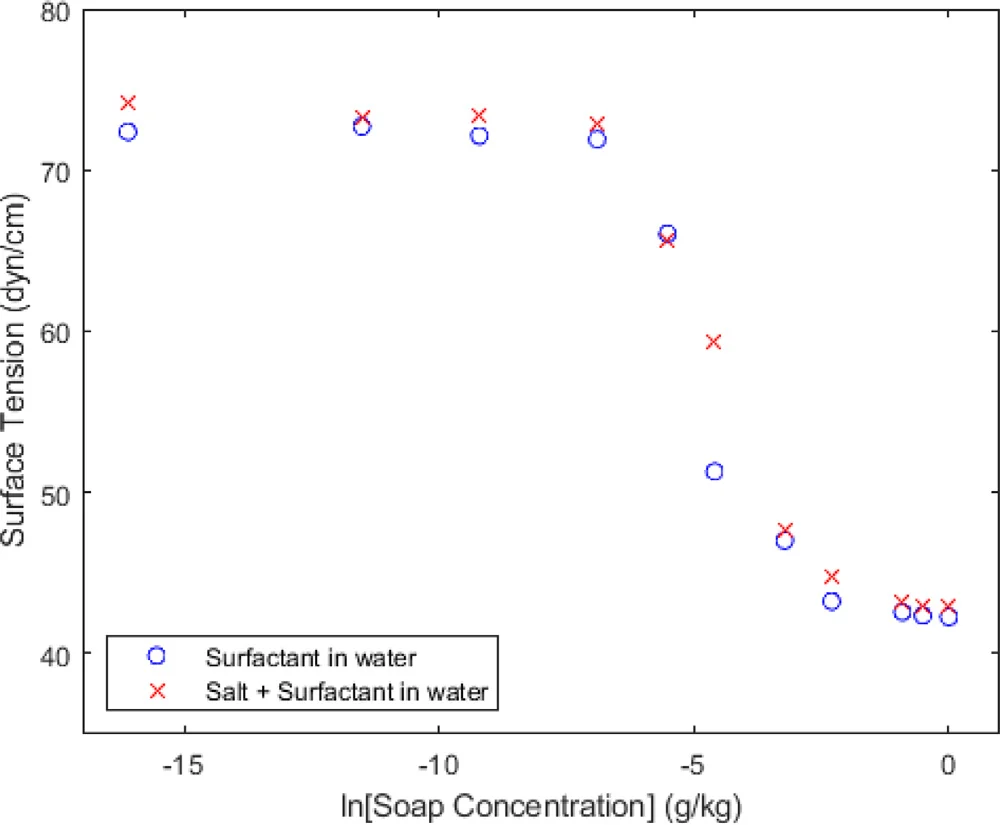
Dissolved salt raises the surface tension of water, and surfactants lower it. Seawater at 35 g/kg has a surface tension of about 73.3 mN/m against 72.4 mN/m for fresh water, while enough soap pulls it down to about 42 mN/m. A freshwater drop dilutes both, so it pushes the local surface tension in opposite directions depending on which solute dominates. Flow along a surface runs from low surface tension toward high surface tension. This is the Marangoni effect.
Saltwater
Dilution lowers the surface tension at the impact point.
Solutocapillary flow runs outward, away from the impact
Surfactant-laden water
Dilution raises the surface tension at the impact point.
Reverse Marangoni flow runs inward, toward the impact
Three dimensionless groups set the outcome. The Weber number We compares the drop's inertia with surface tension. The salt and surfactant Marangoni numbers, Ma1 and Ma2, measure how strongly each solute drives flow along the surface. For 35 g/kg salt, Ma1 = 5.2 × 10⁶. Across our surfactant concentrations, Ma2 spans 1.5 × 10³ to 9.4 × 10⁹.
Experiments
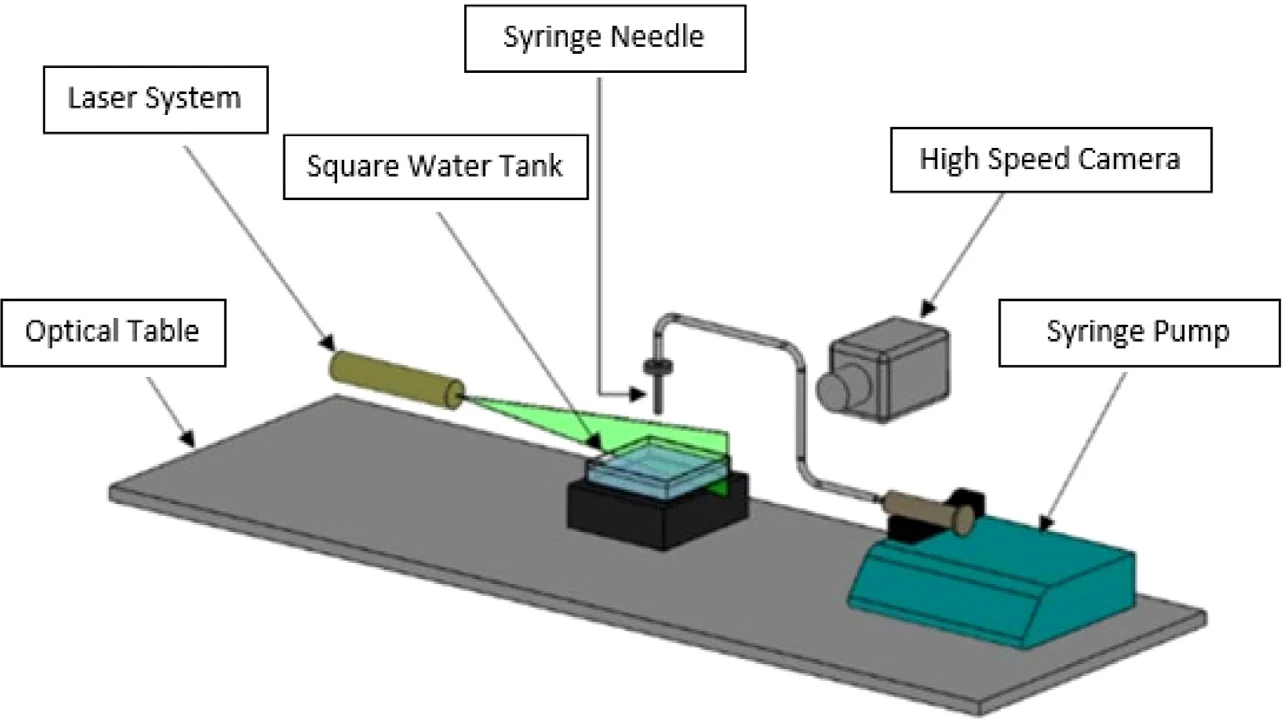
A syringe pump running at 50 µl/min fed an 18-gauge needle with a 0.838 mm bore, which released freshwater drops 3.4 mm in diameter onto a 30 × 30 × 10 cm glass tank of distilled, salt or surfactant water. Raising the needle from 5 to 60 cm above the surface set the impact speed, 0.9 to 2.9 m/s, and the Weber number, 40 to 385.
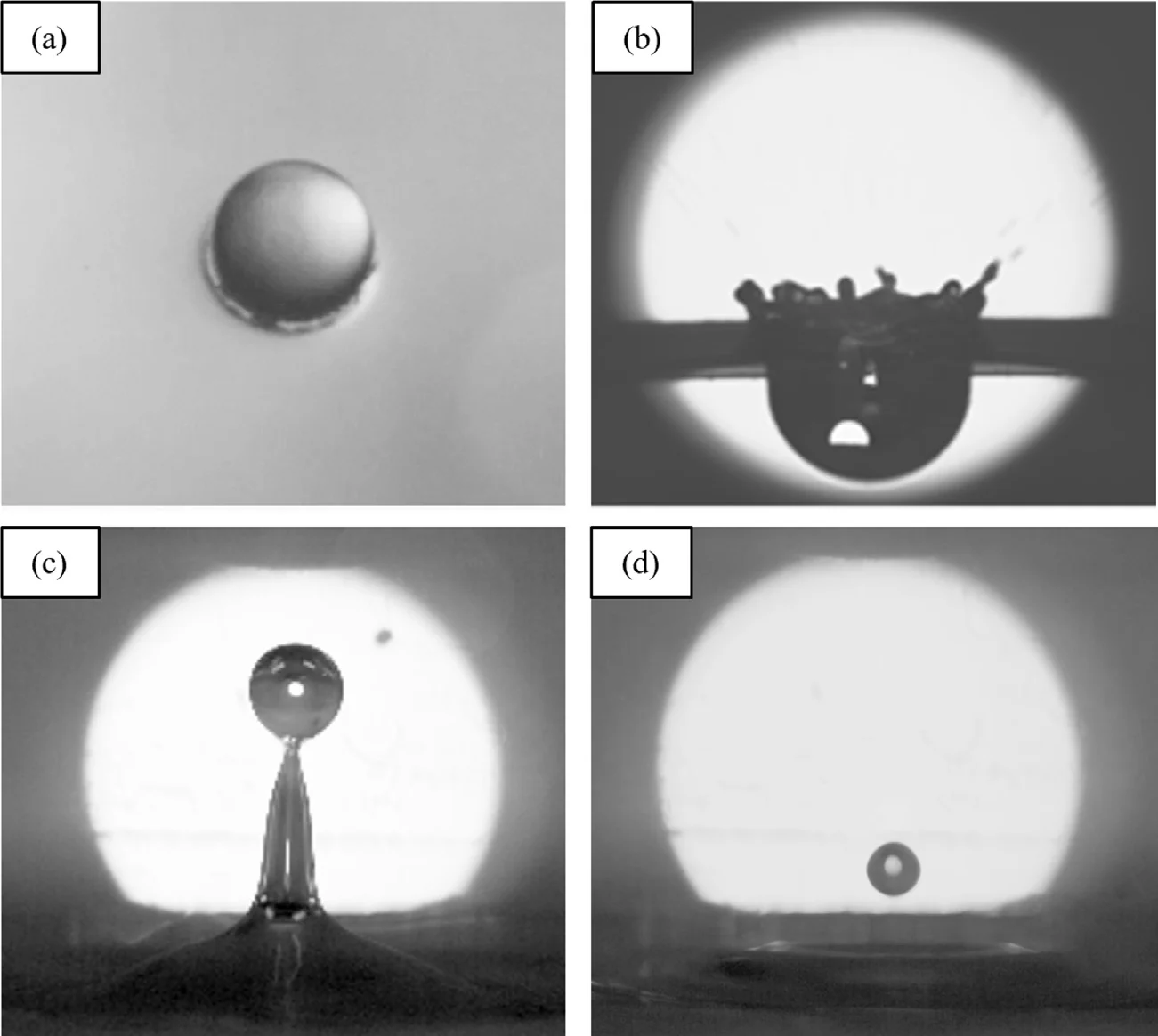
The water was seeded with silver-coated hollow glass particles, 8 to 12 µm across. A 40 mW, 532 nm laser sheet lit a vertical plane through the impact point, and a Phantom Miro-Lab320 high-speed camera recorded it at right angles, at 300 frames per second. PIVlab turned the particle motion into velocity fields. A light source behind the tank gave silhouette images for the height of the water column.
| Drop height | Impact velocity | Weber number | Reynolds number |
|---|---|---|---|
| 5 cm | 0.9 m/s | 40.2 | 213 |
| 10 cm | 1.3 m/s | 78.5 | 298 |
| 20 cm | 1.8 m/s | 148.3 | 410 |
| 40 cm | 2.4 m/s | 272.8 | 556 |
| 60 cm | 2.9 m/s | 384.8 | 660 |
Fresh water
Saltwater, 35 g/kg
Surfactant water
Fresh water: a vortex, little surface flow
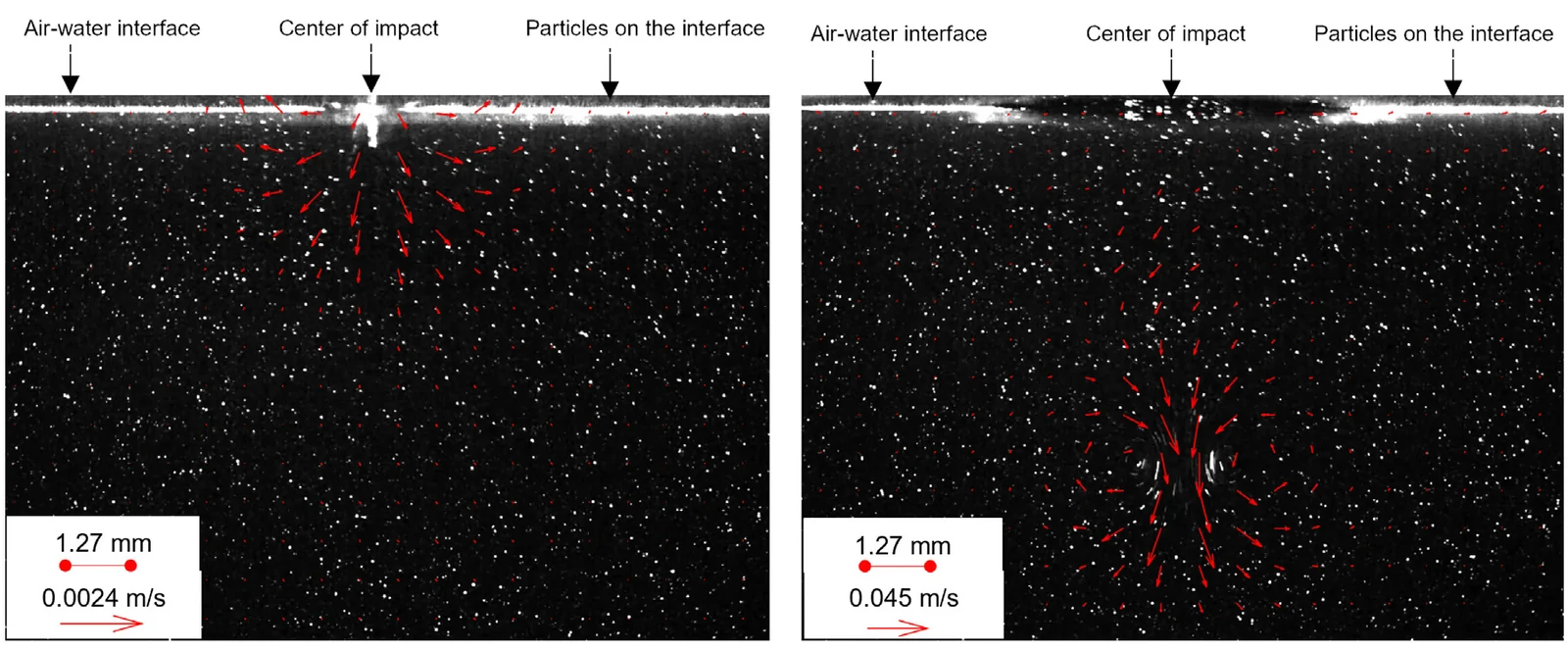
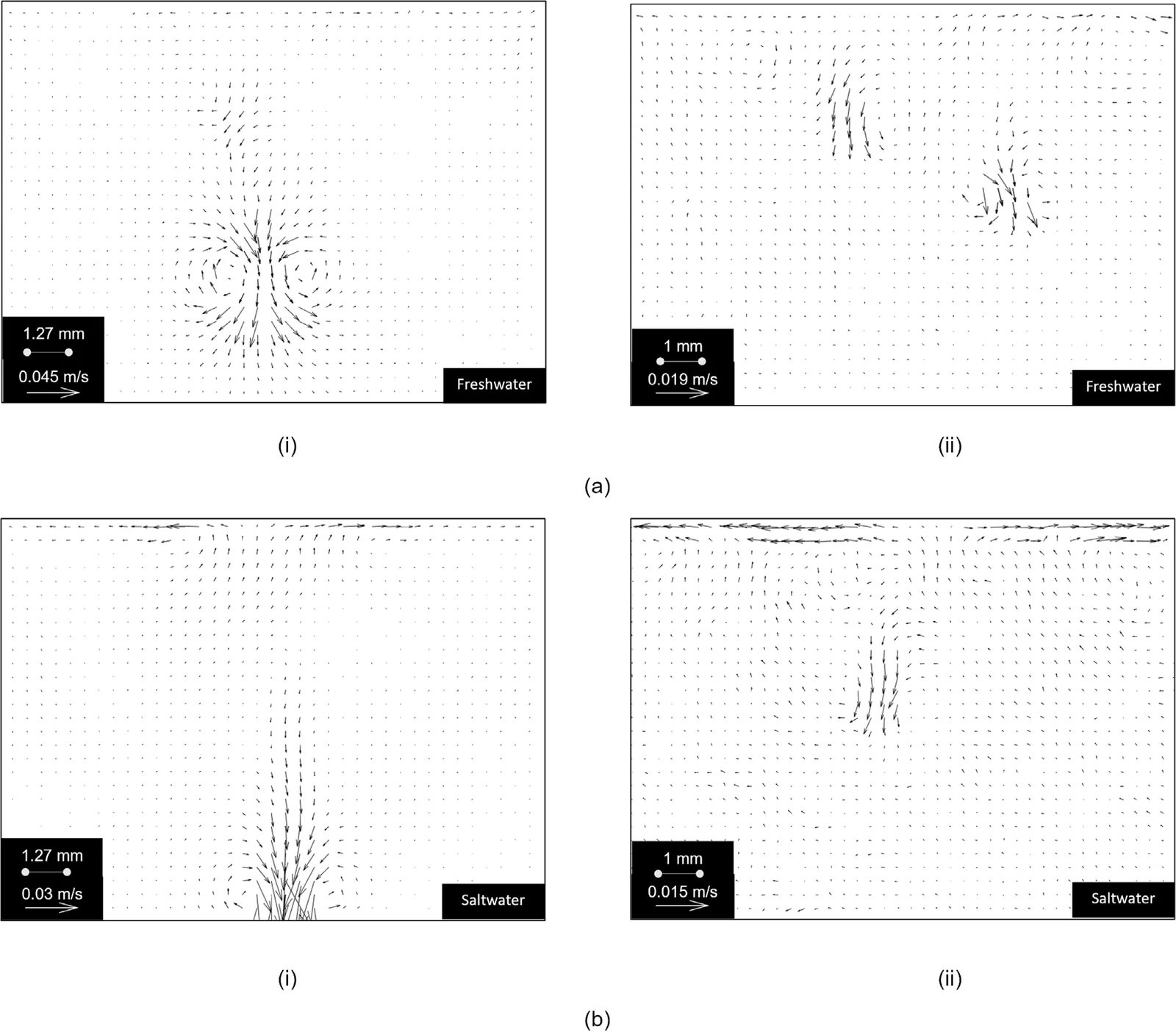
On a freshwater body, the impact drives a vortex ring down into the water. For a drop from 5 cm, it descended at about 13.1 cm/s. The surface itself barely moves. Particles at the impact point were carried under, but those just outside it stayed put, and the flow at the surface died out within about half a second.
Saltwater: a stronger, longer outward flow
On 35 g/kg saltwater, the drop's dilution sets up a solutocapillary doublet. Fluid runs outward along the surface and back toward the impact point just beneath it. The vortex is slower, about 8.6 cm/s, but the surface flow lasted roughly 2.6 s, about seven times longer than on fresh water, and it swept a larger region clear of particles.
Buoyancy helps. The drop's fresh water is lighter than the seawater, so after its momentum carries it down, it rises back to the surface, mixing as it goes, and keeps feeding the outward flow.
Surfactant: the flow turns around
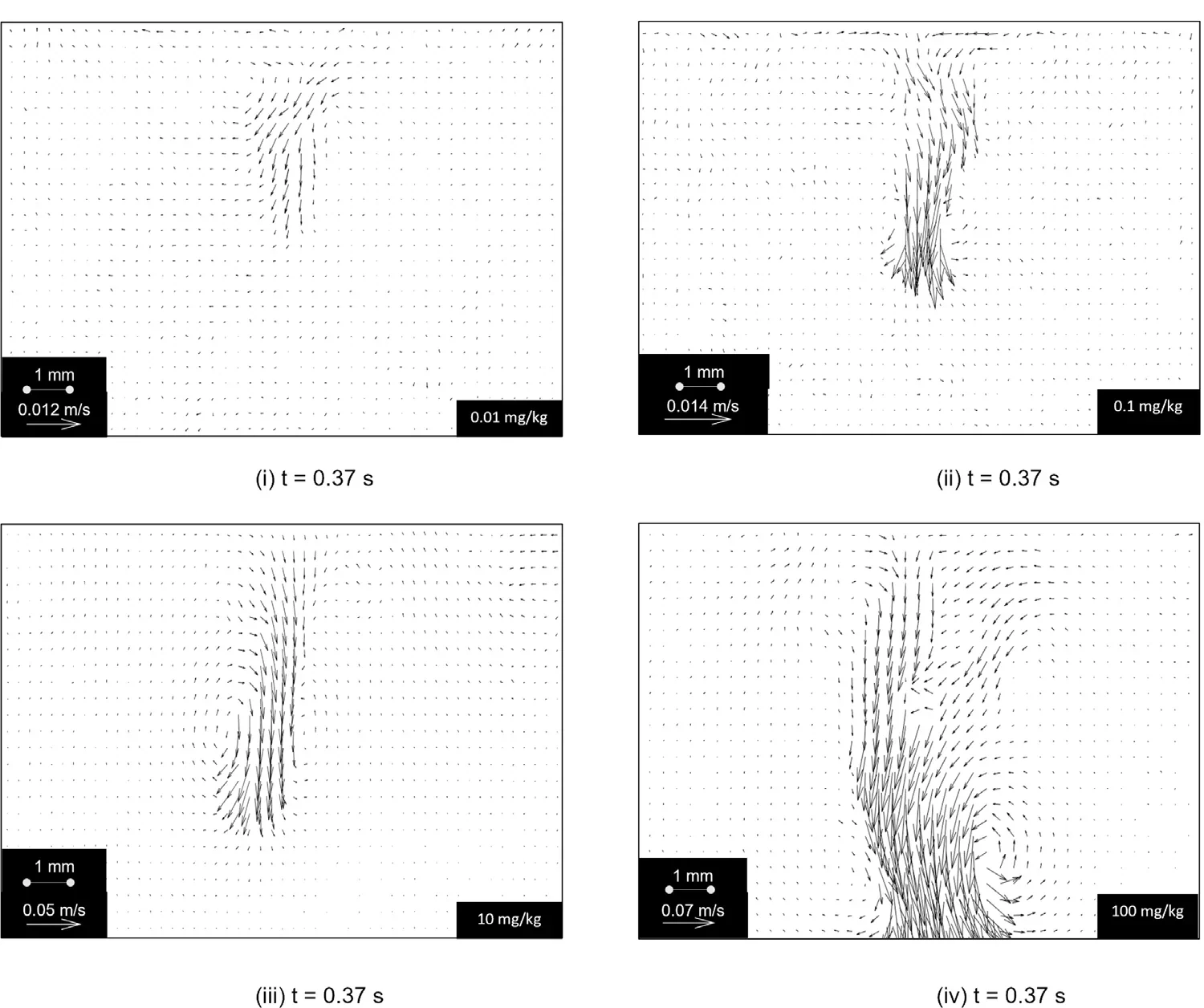
With surfactant in the water, the outward flow from the impact reverses quickly, and the region cleared of particles closes up within fractions of a second. Above about 1 mg/kg (Ma2 ≥ 1.5 × 10⁷), the vortex gives way to a continuous jet below the impact point. For drops released from 20 cm, the jet reached about 2.4 cm into the water, and its speed increased with concentration.
At high surfactant concentrations, adding 35 g/kg salt made little difference, because the reverse Marangoni flow suppressed the solutocapillary flow.
Trends with impact speed
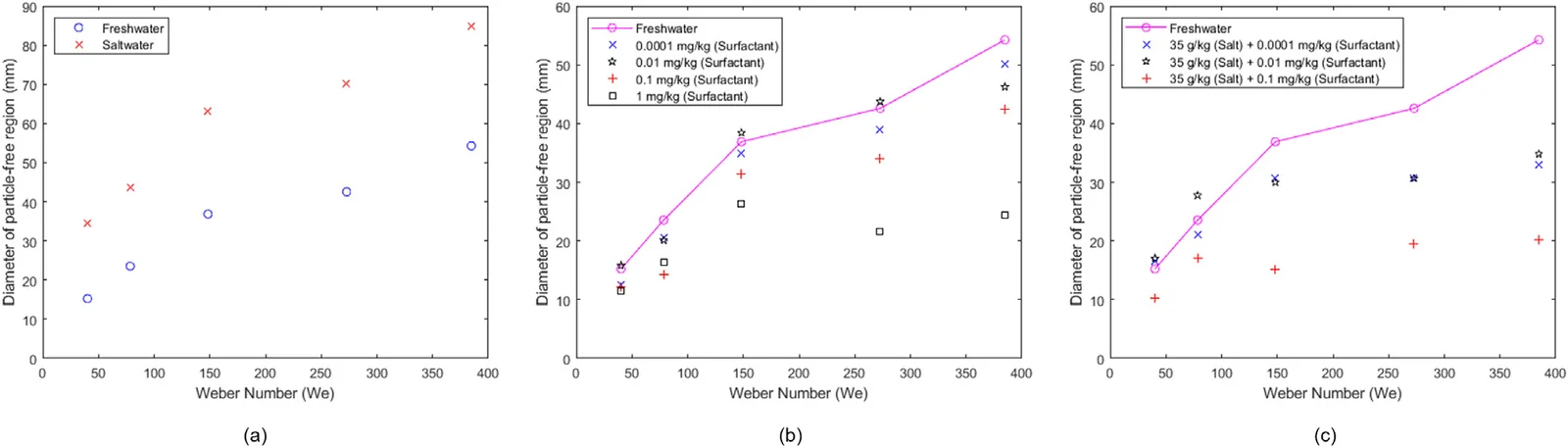
The particle-free region is a direct gauge of the outward surface flow. Its diameter grew with the Weber number and with salt, and shrank as surfactant concentration rose: surfactant halved it, from 30.7 mm to 15.2 mm. Above 1 mg/kg the reverse flow closed it before it could be measured.
Fresh water
Saltwater, 35 g/kg
Surfactant, 1 mg/kg
Salt and surfactant
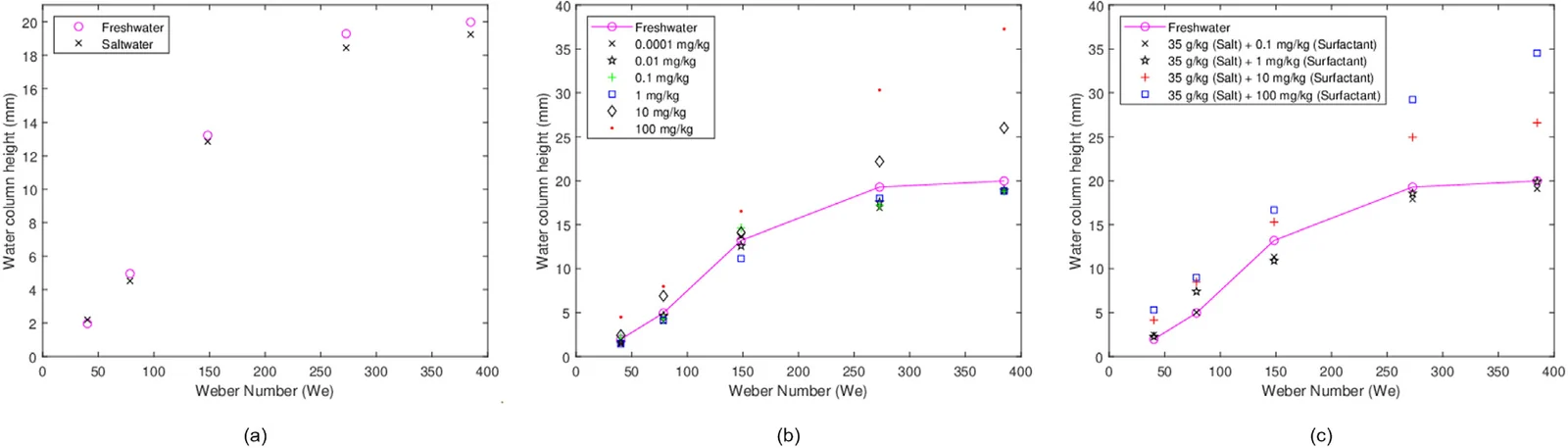
The column of water that rises after impact grows taller with the Weber number. Salt lowers it slightly. Surfactant above 1 mg/kg makes it taller for drops released from higher than 10 cm. Each point is an average of over 20 drops, with a standard deviation under 1.6 mm.
Why it matters
The ocean surface is rarely clean. Natural surfactants collect in the surface microlayer, and salinity shifts with rain, river inflow and melting ice. The same raindrop can stir that surface outward for seconds or send a jet straight down, depending on its chemistry. Both carry gas-rich surface water into the bulk, which is why this flow matters when estimating how rain affects the exchange of gases between air and water.
The same questions carry into my dissertation, which measures how fast CO₂ crosses the air–water interface as salt and surfactant concentrations change.
Verma, S., Benouaguef, I., Musunuri, N., Fischer, I. S., Singh, P. (2023). Marangoni flow induced in a waterbody by the impact of a raindrop. Mechanics Research Communications 133, 104187. doi:10.1016/j.mechrescom.2023.104187. Figures 2 to 9 are reproduced from this article, © 2023 Elsevier Ltd.